
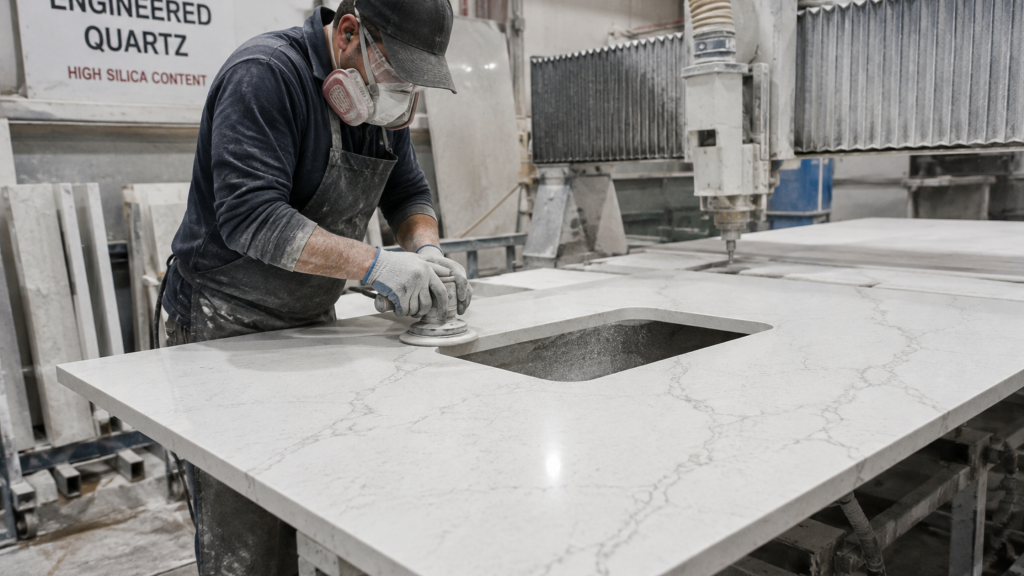
A recent California story is drawing renewed attention to a serious occupational disease affecting workers who cut, grind, polish, and fabricate engineered stone countertops: silicosis.
As we previously discussed in our blog, “Silicosis & Airborne Dust: The Hidden Dangers of Working in Stone Fabrication,” workers in stone fabrication can be exposed to extremely small particles of respirable crystalline silica. When these particles are inhaled, they can travel deep into the lungs and cause permanent damage.
A recent report involving a longtime Southern California stone worker demonstrates just how serious that damage can become. After developing advanced silicosis and becoming unable to work, the worker ultimately underwent a double lung transplant.
His experience is an important reminder for stone fabrication workers throughout California: silica exposure is not simply a dusty-workplace problem. It can become a life-changing and potentially fatal occupational disease.
A California Worker’s Experience Brings Attention to Silicosis
According to recent news coverage, 56-year-old Enrique Gonzalez spent years working in granite and stone manufacturing before developing severe silicosis.
His condition eventually became so serious that he could no longer work and struggled with basic physical activities because of difficulty breathing. His health reportedly deteriorated to the point that he required a double lung transplant.
Following the transplant, his family reported substantial improvement in his ability to breathe, walk, and communicate, although his recovery continues to involve extensive medical treatment, rehabilitation, and follow-up care.
The details of one worker’s experience should not be interpreted as the expected medical course for every person diagnosed with silicosis. However, the case illustrates the potentially devastating consequences of prolonged occupational exposure to respirable crystalline silica.
It is also part of a much broader workplace health concern in California.
California Is Responding to a Serious Silicosis Problem
California regulators have increasingly focused on silica exposure in the artificial and engineered stone industry.
Cal/OSHA warns that exposure to silica from artificial stone can cause rapid development of severe silicosis and describes the disease as permanently disabling and frequently fatal. The agency also identifies silica exposure as a risk factor for lung cancer, kidney disease, autoimmune disease, and other serious health problems.
The concern has become serious enough that, in May 2026, California’s Occupational Safety and Health Standards Board advanced a proposal aimed at prohibiting fabrication and installation of artificial stone products containing more than 1% crystalline silica. Cal/OSHA subsequently convened an advisory meeting in July 2026 as part of the emergency rulemaking process. As of this writing, that proposal should not be confused with an already-effective ban; it remains part of an ongoing regulatory process.
These developments demonstrate the seriousness with which California workplace safety authorities are treating the risk.
Why Is Engineered Stone So Dangerous to Workers?
The finished countertop in a home is not necessarily where the greatest occupational danger occurs. The significant risk arises during fabrication and installation, when workers cut, grind, drill, polish, or otherwise disturb silica-containing material.
Those processes can release microscopic particles of respirable crystalline silica into the air.
Because these particles are extremely small, workers may inhale them deep into their lungs. Repeated or intense exposure can cause inflammation and permanent scarring.
Artificial stone can present an especially significant hazard. Cal/OSHA states that artificial stone fabrication can expose workers to particularly dangerous silica dust and has adopted strengthened rules specifically addressing high-exposure tasks in the industry.
This means a countertop that appears harmless once installed can involve substantial occupational risks for the workers responsible for fabricating it.
Silicosis May Develop Before a Worker Realizes How Serious the Exposure Has Been
One of the dangers of occupational silica exposure is that workers may not immediately recognize that their lungs are being damaged.
Symptoms of silicosis can include:
- Persistent coughing
- Shortness of breath
- Chest discomfort or pain
- Fatigue
- Difficulty performing physical activity
- Unexplained weight loss
- Increasing difficulty breathing
Workers should not assume that breathing problems are simply part of working in a dusty environment.
Silicosis is incurable, and severe cases can become permanently disabling or fatal. Cal/OSHA has specifically warned that uncontrolled artificial stone fabrication represents a significant health hazard.
Anyone who has worked around engineered stone, quartz, granite, concrete, or other silica-containing materials and develops respiratory symptoms should tell their medical provider about their occupational exposure.
California Requires Employers to Protect Stone Fabrication Workers
Employers cannot simply accept dangerous levels of silica dust as an unavoidable part of stone fabrication.
California has specific workplace safety requirements addressing respirable crystalline silica. The state strengthened its protections after identifying serious risks among workers performing high-exposure tasks such as cutting, grinding, polishing, and cleaning up artificial and natural stone.
Depending on the work being performed, required protections can include measures involving:
- Wet cutting and other methods designed to suppress dust
- Proper ventilation and engineering controls
- Air monitoring
- Appropriate respiratory protection
- Safe housekeeping and cleanup procedures
- Worker training
- Medical surveillance under qualifying circumstances
California’s rules also prohibit certain unsafe practices in covered high-exposure work, including dry sweeping and the use of compressed air for prohibited cleanup activities.
Workers should not have to choose between earning a paycheck and protecting their lungs.
What If You Already Have Symptoms of Silica Exposure?
If you currently work—or previously worked—in stone fabrication and are experiencing breathing problems, do not ignore the symptoms simply because you are no longer exposed to the dust.
Consider taking the following steps:
- Seek medical attention and explain your complete work history.
- Tell your doctor specifically that you worked around engineered stone, quartz, granite, concrete, or silica dust.
- Explain the tasks you performed, including cutting, grinding, polishing, drilling, or cleaning.
- Keep copies of medical records, imaging results, pulmonary testing, and diagnoses.
- Write down the names and locations of the companies where you performed stone fabrication work.
- Document approximately how long you worked at each location and the types of materials you handled.
- Preserve any available information about respiratory protection, ventilation, wet-cutting practices, and workplace conditions.
- Speak with a workers’ compensation attorney about whether your illness may be work-related.
Occupational disease cases can involve years of exposure and sometimes multiple employers, so preserving an accurate employment history can be especially important.
Can Silicosis Qualify for California Workers’ Compensation?
A work-related illness can potentially qualify for workers’ compensation just as a workplace accident can.
California’s workers’ compensation system provides benefits for qualifying occupational injuries and illnesses. Depending on the circumstances, a worker with occupational silicosis may be entitled to benefits related to medical care and disability.
Potential benefits can include:
- Medical treatment
- Specialist care
- Diagnostic testing
- Prescription medication
- Temporary disability benefits
- Permanent disability benefits
- Supplemental job displacement benefits when applicable
- Death benefits for eligible dependents in fatal cases
Silicosis claims can be particularly complicated because exposure and disease may develop over many years. Determining when and where harmful exposure occurred can require medical evidence, employment records, and a detailed occupational history.
Workers May Have Legal Questions Beyond Workers’ Compensation
Some silica cases may raise legal issues beyond a standard workers’ compensation claim, depending on how the exposure occurred and which companies or products were involved.
For example, a case could involve questions concerning manufacturers, distributors, suppliers, contractors, or other third parties.
Whether an additional claim exists is highly fact-specific. Workers should not assume that a news report involving litigation means the same type of lawsuit is available in every silica case.
An attorney can review the worker’s employment history, exposure, medical diagnosis, and potentially responsible parties to determine which legal options may apply.
Your Immigration Status Does Not Take Away Your Workers’ Compensation Rights
This point is especially important for California’s stone fabrication workforce.
Some immigrant workers may be afraid to report respiratory symptoms, discuss unsafe working conditions, or seek legal assistance because they are concerned about their immigration status.
California workers’ compensation protections apply regardless of immigration status.
The California Department of Industrial Relations states that workers employed in California are eligible for workers’ compensation benefits for qualifying work-related injuries or illnesses regardless of citizenship or immigration status. The state also states that its labor laws protect workers regardless of immigration status and prohibit immigration-related retaliation for exercising protected workplace rights.
Being undocumented does not mean that an employer can simply ignore a workplace illness.
It also should not prevent a worker from seeking medical attention or asking an attorney about a potential claim.
At Kinsler Law, your immigration status does not determine whether we will review your case.
Stone Workers Throughout Southern California Should Know the Risks
The recent case involving a Southern California father who ultimately required a double lung transplant puts a human face on an occupational hazard that can otherwise seem abstract.
Silica exposure is not simply about coughing at work.
It can affect whether someone can continue earning a living, whether they can walk without becoming short of breath, whether they require lifelong medical treatment, and—in the most severe cases—whether they survive.
California regulators have already strengthened silica protections and are considering additional restrictions because of the seriousness of the engineered-stone silicosis crisis.
Workers should take symptoms seriously, and employers must take prevention seriously.
How Kinsler Law Can Help Workers Exposed to Silica Dust
At Kinsler Law, we represent workers who have suffered injuries and occupational illnesses throughout California, including workers in Oxnard, Ventura, Santa Paula, Camarillo, the San Fernando Valley, Los Angeles County, Ventura County, and other communities throughout the state.
We can help workers understand issues involving:
- Occupational silicosis
- Engineered stone and quartz exposure
- Workers’ compensation claims
- Medical treatment
- Temporary and permanent disability
- Denied workers’ compensation claims
- Workplace retaliation
- Potential additional legal claims when applicable
Most importantly, we can review your case regardless of your immigration status or where you are located in California.
Contact Kinsler Law for a Free Consultation
If you have worked cutting, grinding, polishing, drilling, or fabricating engineered stone and have developed breathing problems or have been diagnosed with silicosis or another silica-related illness, it is important to understand your rights.
You do not have to wait until your condition becomes severe before asking questions.
Kinsler Law offers free consultations by phone or Zoom in English and Spanish. We represent injured and ill workers throughout California, and your immigration status does not matter.
Contact Kinsler Law today to discuss your occupational exposure, workers’ compensation rights, and any other legal options that may be available.